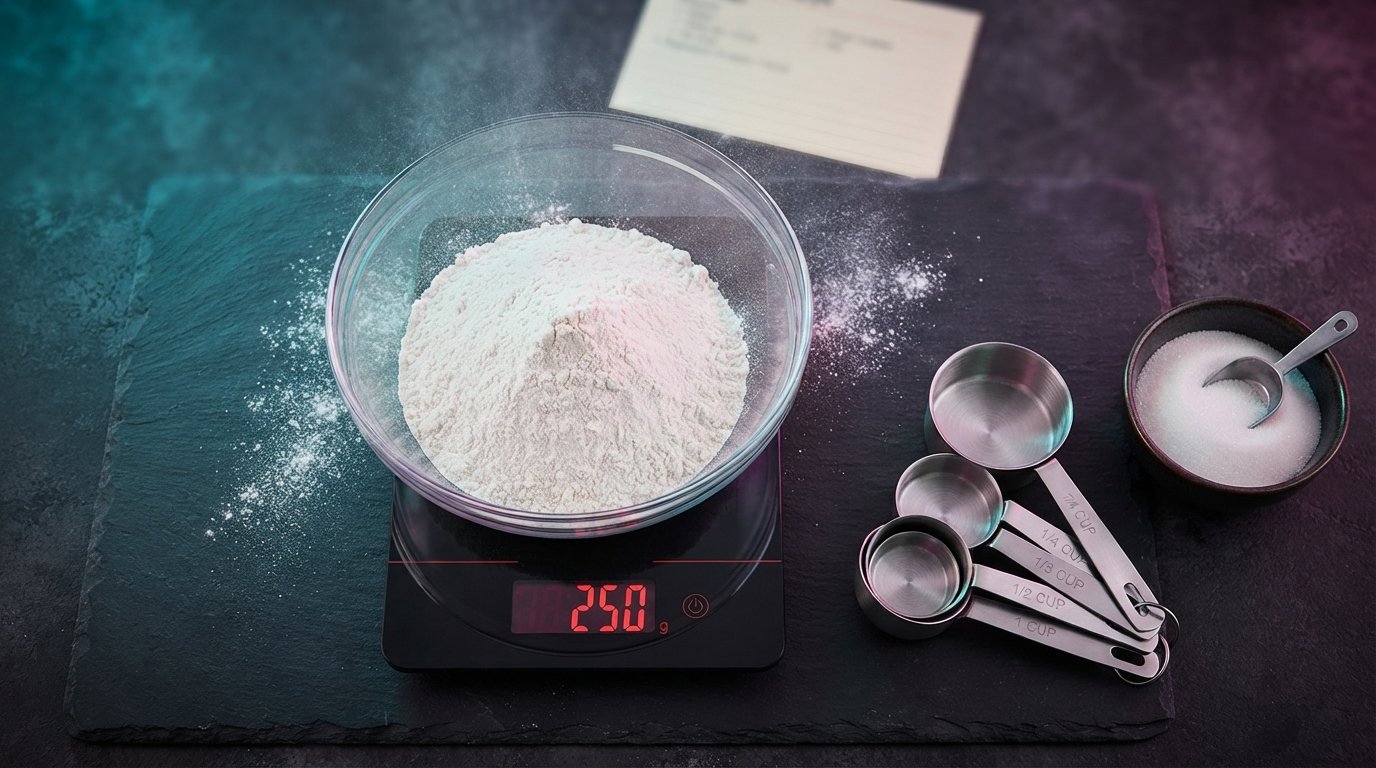
Found a great recipe on a European blog, but your kitchen runs on measuring cups? You're not alone. The quick answer: divide the grams by the ingredient's grams per cup. That means 100 grams of flour is about 0.83 cups, 100 grams of sugar is ½ cup, and 100 grams of butter is about 0.44 cups. Below you'll learn how to convert grams to cups for any ingredient, how to turn messy decimals into real kitchen measures, and how to avoid the mistakes that ruin recipes.
The Grams to Cups Formula
Grams measure weight and cups measure volume, so there is no single gram to cup number. Every ingredient has its own density. The formula is:
Cups = Grams ÷ Grams per cup
For example, 300 g of flour ÷ 120 g per cup = 2.5 cups. 400 g of sugar ÷ 200 g per cup = 2 cups.
The grams-per-cup values in this guide follow the US customary cup (236.6 ml) and match the widely used King Arthur Baking ingredient weight chart. For the opposite direction, see our guide to cups to grams.
How to Convert Grams into Cups in 4 Steps
- Find the grams per cup of your ingredient (flour 120, sugar 200, butter 227).
- Divide the recipe's grams by that number.
- Round sensibly to a measure you can actually fill (¼, ⅓, ½, ⅔, ¾ cup).
- Use tablespoons for the leftover amount (1 cup = 16 tablespoons).
Prefer not to calculate? Our free grams to cups converter does it instantly for dozens of ingredients.
Grams to Cups Chart for Common Weights
Grams
Flour (cups)
Sugar (cups)
Butter (cups)
50 g
0.42
0.25
0.22
100 g
0.83
0.50
0.44
150 g
1.25
0.75
0.66
200 g
1.67
1.00
0.88
250 g
2.08
1.25
1.10
300 g
2.50
1.50
1.32
500 g
4.17
2.50
2.20
Looking for one exact weight? Check our dedicated pages for 100 grams to cups and 250 grams to cups, or the ingredient guides for flour, sugar and butter.
Turning Decimals into Real Kitchen Measures
A calculator might say "0.83 cups," but no measuring cup has that line. Convert the decimal into cups plus tablespoons:
- 100 g flour (0.83 cup): ¾ cup plus 1 tablespoon
- 200 g flour (1.67 cups): 1⅔ cups
- 250 g flour (2.08 cups): 2 cups plus 1 tablespoon
- 500 g flour (4.17 cups): 4 cups plus about 2½ tablespoons
- 100 g butter (0.44 cup): 7 tablespoons
- 200 g butter (0.88 cup): 14 tablespoons
Butter is the easy one: 113 g is one stick (½ cup) and 227 g is two sticks. Sugar is just as friendly because 200 g is exactly 1 cup.
A Real Example: Converting a Cookie Recipe
Suppose a UK recipe lists these amounts:
- 250 g plain flour → 250 ÷ 120 = 2.08, so 2 cups + 1 tablespoon
- 200 g granulated sugar → 200 ÷ 200 = 1 cup
- 115 g butter → 115 ÷ 227 = 0.51, so 1 stick (½ cup)
Three ingredients, three quick divisions, and the recipe is ready for your measuring cups. Caster (superfine) sugar is slightly lighter, at roughly 190 g per cup, so the same 200 g comes out just over 1 cup.
Why Grams to Cups Is Less Accurate Than You Think
Here is the honest part: converting grams into cups adds error. The recipe author weighed their ingredients precisely, and you are now estimating by volume. Flour is the main culprit. How you fill the cup can change the weight by 20 grams or more, which is explained in detail in our cups to grams guide.
To keep the error small:
- Convert only what you must. If you own a kitchen scale, use the grams.
- Be most careful with flour, cocoa and powdered sugar. They compress easily.
- Be relaxed with sugar, water and butter. They are consistent.
- Round gently. A cookie recipe forgives ¼ cup of rounding. A delicate sponge cake does not.
- Hold back a spoonful. If dough looks too dry or wet, adjust at the end instead of guessing at the start.
Common Mistakes When You Convert Grams to Cups
- Using water's number for everything. Dividing 100 g of flour by 237 gives 0.42 cups, which is half the right amount.
- Rounding too early. Round the final answer, not each step.
- Ignoring the ingredient type. Bread flour, cake flour and almond flour differ, and so do caster and brown sugar.
- Mixing cups and grams in one recipe. Pick one system per ingredient list.
- Forgetting liquids. Milk and water are close to 240 g per cup, but honey is about 340 g, so 100 g of honey is only 0.29 cups.
For anything unusual, check the USDA FoodData Central database for an ingredient's density, or see how we pick our numbers on our methodology page.
Frequently Asked Questions
How many cups is 100 grams?
It depends. 100 g of flour is about 0.83 cups, sugar is ½ cup, butter is 0.44 cups, and water is about 0.42 cups.
How many cups is 250 grams of flour?
About 2.08 cups, or 2 cups plus 1 tablespoon.
Is 100 grams equal to ½ cup?
Only for granulated sugar. For flour, ½ cup is about 60 g.
What is the easiest way to convert a gram to cup measurement?
Divide by the ingredient's grams per cup, or use a converter and a printable chart you can stick on the fridge.
Can I use the same grams to cups ratio for liquids and dry ingredients?
No. Water-like liquids are near 237 g per cup, while dry ingredients are much lighter.
Final Thoughts
To convert grams to cups, divide by the ingredient's weight per cup, round to a practical measure and, when possible, weigh the flour instead. Keep the chart above handy, or let our grams to cups converter do the math. Your next recipe from abroad will turn out just as the author intended.
Ready to convert your recipe?
Open the ConverterKeep reading
Cups to Grams: Easy Conversion Chart for Flour, Sugar, Butter & More
Convert cups to grams for flour, sugar, butter and more. See how many grams are in a cup, with an easy chart, formula and tips for accurate baking.
Read article